
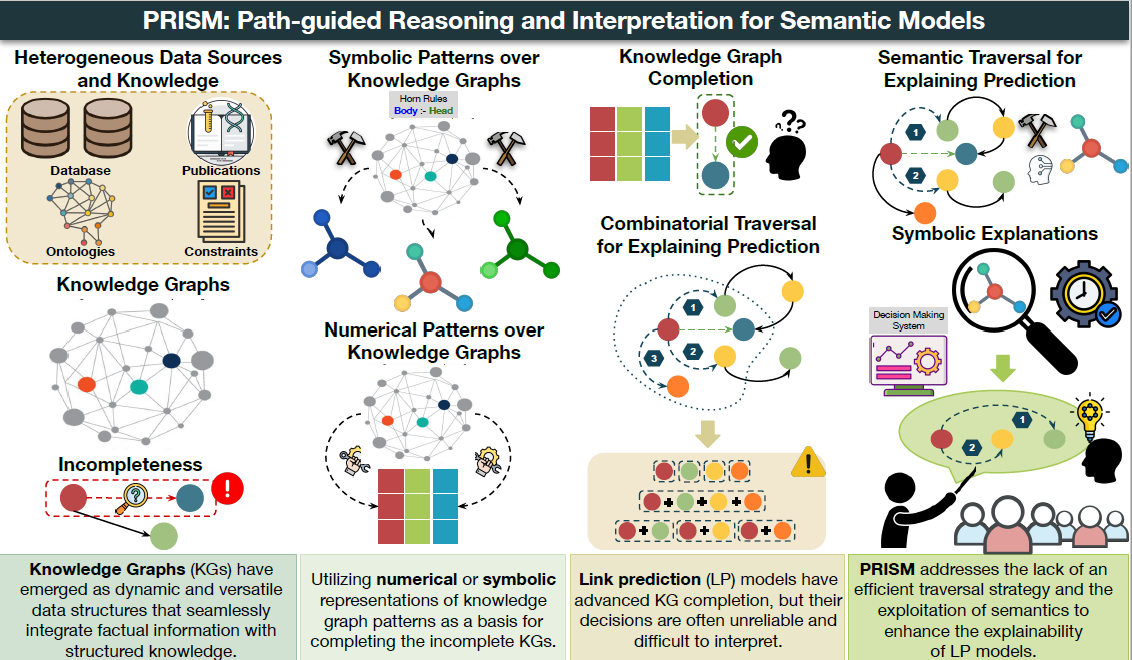
PRISM is a neuro-symbolic explanation framework for Link Prediction (LP) over Knowledge Graphs (KGs). It explains why a Knowledge Graph Completion (KGC) model predicts a missing fact by identifying the facts that are most relevant to the prediction.
PRISM combines symbolic reasoning with Knowledge Graph Embeddings (KGEs) to generate explanations that are:
- Faithful to the behaviour of the underlying LP model.
- Interpretable through explicit KG facts and symbolic reasoning patterns.
- Efficient by reducing the number of candidate facts that must be explored.
🎯 PRISM builds on top of the KELPIE [1] framework and extends it with neuro-symbolic explanation strategies that exploit both explicit semantic knowledge and latent embedding-based representations.
PRISM associates each predicted relationship with two complementary forms of explanation:
- Necessary explanations identify facts that are essential for the prediction. Removing these facts should weaken or invalidate the predicted relationship.
- Sufficient explanations identify additional facts that support the predicted relationship. Adding or emphasizing these facts should strengthen the prediction.
We empirically evaluate PRISM across 336 testbeds for necessary explanations and 336 testbeds for sufficient explanations, assessing explanation quality, faithfulness, interpretability, and computational efficiency.
Note: The complete reproducibility of all testbeds is estimated to require approximately five or six months.
Below is an example of how PRISM explains a missing link prediction in a KG:

The figure illustrates how PRISM uses symbolic rules, KG structure, and embedding-based relevance signals to generate necessary and sufficient explanations for a predicted missing relationship.
| Path | Description |
|---|---|
data/ |
All experiment-related artifacts. |
├── 0_rules/ |
Symbolic rules used during explanation generation. |
├── 1_triple_store/ |
KG triples, including train, validation, and test splits. |
├── 2_stored_models/ |
Pre-trained KGE models. |
├── 3_filtered_ranks/ |
LP model predictions with ranking information. |
├── 4_predictions/ |
Tab-separated triples used as input for explanation generation. |
├── 5_explanations/ |
Explanations generated by PRISM and used for verification. |
├── 6_statistics/ |
Evaluation metrics from explanation generation and verification. |
├── 7_logging/ |
Logs for tracking experimental runs. |
├── temp/ |
Temporary files generated during rule and triple processing. |
scripts/ |
Benchmark-specific folders containing run.sh scripts and configuration files. |
src/ |
Source code of the project. |
├── embeddings/ |
Training, testing, explanation, and verification scripts for KGE models. |
├── explanation_builders/ |
Logic for constructing necessary and sufficient explanations. |
├── link_prediction/ |
Embedding model implementations and LP utilities. |
├── model/ |
PRISM and KELPIE architecture logic. |
├── prefilters/ |
Filtering strategies for selecting semantically relevant candidate facts. |
├── relevance_engines/ |
Score computation for candidate explanatory triples. |
├── rules/ |
Code and binaries for symbolic rule mining. |
create_environment.sh |
Shell script to install Python dependencies. |
requirements.txt |
Python dependency list. |
config.py |
Project-wide configuration values. |
Reproducing the results in our study is straightforward with the provided scripts and input configurations.
-
Set up the environment
bash create_environment.sh
-
Prepare symbolic rules
Run AMIE [2] with the appropriate training triples:
java -jar amie -const -minpca 0.7 -dpr -optimai path/to/train.txt > path/to/rules.txt -
Navigate to a benchmark folder
cd scripts/FrenchRoyalty # or DB100K, FB15K-237, YAGO3-10
-
Edit the input configuration
Update
input.jsonor the benchmark-specific configuration file to specify:- the explanation mode:
necessaryorsufficient, - the embedding model:
TransE,ComplEx, orConvE, - the explanation builders to be used,
- the rule files and prediction files.
- the explanation mode:
-
Run explanation generation
bash run.sh
-
Analyze the results
Explanation and verification metrics are stored in the
data/folder, especially in:6_statistics/7_logging/
🧪 Our full experimental pipeline was executed using:
- OS: Ubuntu 20.04.5
- Python: 3.10
- GPU: NVIDIA A100 with 40 GiB VRAM
- CUDA: 12.2
Navigate to a benchmark-specific folder and execute run.sh to generate explanations:
cd scripts/FrenchRoyalty
bash run.sh
This executes the explanation extraction script, for example transe-fr-script.py, using the configuration specified in input_transe_fr.json. The script generates explanations across the selected explanation builders and stores the outputs in the corresponding data/ subfolders.
{
  "dataset": "FR_Reduced_2K",
  "embedding_model": "TransE",
  "predictions": "FR_10.csv",
  "rules_file": "fr_reduced_2k_rules_optimai.csv",
  "editorial_rules": "FR_editorial_rules.csv",
  "dimension": 50,
  "batch_size": 1906,
  "negative_samples_ratio": 5,
  "e_regularizer_weight": 50.0,
  "v_regularizer_weight": 2.0,
  "margin": 2,
  "e_learning_rate": 0.003,
  "v_learning_rate": 0.00003,
  "e_epochs": 100,
  "v_epochs": 10,
  "thr": 0.7,
  "coverage": 3,
  "mode": "sufficient",
  "builders": ["kelpie", "pca", "frequency"]
}| Parameter | Description |
|---|---|
dataset |
Name of the dataset, for example FR_Reduced_2K. |
embedding_model |
KGE model used for LP, such as TransE, ComplEx, or ConvE. |
predictions |
CSV file containing the predictions to explain. |
rules_file |
Symbolic rules generated by AMIE. |
editorial_rules |
Optional user-defined rules. |
dimension |
Embedding vector dimension. |
batch_size |
Batch size for model training. |
negative_samples_ratio |
Number of negative samples per positive triple. |
e_regularizer_weight |
Regularization weight for embedding training. |
v_regularizer_weight |
Regularization weight during verification. |
margin |
Margin used in the loss function. |
e_learning_rate |
Learning rate for embedding training. |
v_learning_rate |
Learning rate for verification. |
e_epochs |
Number of epochs for embedding training. |
v_epochs |
Number of epochs used during verification. |
thr |
Threshold used for rule or candidate filtering, for example PCA confidence. |
coverage |
Number of explanations to return per prediction. |
mode |
Explanation type: necessary or sufficient. |
builders |
List of explanation builders to apply. |
The experimental evaluation encompasses three embedding representation spaces: TransE [6], ConvE [7], and ComplEx [8].
| Model | Epochs | Batch Size | Learning Rate | Embedding Dim |
|---|---|---|---|---|
| TransE | 100 | 2048 | 0.001 | 200 |
| ConvE | 500 | 128 | 0.003 | 200 |
| ComplEx | 50 | 128 | 0.1 | 100 |
💡 These hyperparameters were tuned for fair comparison and consistent results across benchmarks.
| Benchmark | Entities | Relations | Triples |
|---|---|---|---|
| French Royalty | 2,601 | 12 | 10,526 |
| YAGO3-10 | 123,086 | 37 | 1,080,264 |
| FB15K-237 | 40,943 | 18 | 151,442 |
| DB100K | 99,604 | 470 | 695,572 |
-
French Royalty 👑 [3]
A curated KG derived from DBpedia about historical French royals, including facts such as gender, spouse, successor, and related relations.
Entities: 2,601 | Triples: 10,526 | Relations: 12 -
YAGO3-10 🌍 [9]
A dense subset of the multilingual YAGO3 KG with rich information about persons, cities, sports, and organizations.
Entities: 123,086 | Triples: 1,080,264 | Relations: 37 -
FB15K-237 🎬 [10]
A subset of Freebase with inverse relations removed to avoid data leakage, covering domains such as music, sports, film, and people.
Entities: 40,943 | Triples: 151,442 | Relations: 18 -
DB100K 📘 [11]
A DBpedia-derived KG focused on hierarchical and structured relations. Only entities with rich neighborhoods are retained.
Entities: 99,604 | Triples: 695,572 | Relations: 470
This project is licensed under the MIT License.
- Andrea Rossi et al. (2022). Explaining Link Prediction Systems. SIGMOD.
- J. Lajus et al. (2020). Fast and Exact Rule Mining with AMIE 3. ESWC.
- Halliwell et al. (2021). User Scored Evaluation of Non-Unique Explanations. K-CAP.
- Kristina Toutanova and Danqi Chen (2015). Observed versus Latent Features for Knowledge Base and Text Inference. ACL Workshop.
- Jingxiong Wang et al. (2023). Attention-Based High-Low Level Features Interaction for Knowledge Graph Embedding. IPM.
- Bordes et al. (2013). Translating Embeddings for Modeling Multi-Relational Data. NeurIPS.
- Dettmers et al. (2018). Convolutional 2D Knowledge Graph Embeddings. AAAI.
- Trouillon et al. (2016). Complex Embeddings for Simple Link Prediction. ICML.
- Mahdisoltani et al. (2015). YAGO3: A Knowledge Base from Multilingual Wikipedias. CIDR.
- Toutanova et al. (2015). Observed versus Latent Features for Knowledge Base and Text Inference. ACL.
- Wang et al. (2023). Knowledge Graph Embedding Model with Attention-Based High-Low Level Features Interaction Convolutional Network. IPM.