Verifiable Claim-Check Assistant — on-device Gemma 4 inference with cryptographic model attestation via Lemma.
A reference implementation that demonstrates how to bind an AI-generated verdict to the specific model that produced it. If the local model weights are swapped out — even subtly — the cryptographic proof breaks immediately and visibly.
The same primitive runs a second mode: attribute attestation for KYC / DeFi compliance. The TUI ships with --mode attribute and --mode both, so the demo can show one Groth16 circuit cover two domains — AI trust and verifiable compliance — using the same Lemma document-binding flow.
This repository is the public, Apache 2.0 sibling of the longer write-up; see docs/writeup.md for the full motivation and the WOW-moment demo script.
[Claim Input (text)]
       ↓
[Model Attestation] — Ollama /api/tags manifest digest vs. pinned known-good hash
       ↓ (verified)
[Gemma 4 Inference] — local /api/generate, JSON-constrained output
       ↓
[Proof Binding] — poseidon5(toScalar(modelDigest), toScalar(attestationToken), claimHash, outputHash, nonce)
       ↓
[Edge Proving] — Groth16 fullProve via snarkjs (claimCheckCommitmentV1 circuit)
       ↓
[Lemma Submission] — POST /v1/documents + POST /v1/proofs
       ↓
[Verdict] — ✔ VERIFIED · ✘ TAMPERED · ! UNVERIFIED
The on-device pipeline performs edge proving — it generates Groth16 zero-knowledge proofs locally using snarkjs with a Poseidon-commitment circuit (claimCheckCommitmentV1), then submits both the document binding and the proof to the Lemma workers API. The runtime dependencies for the proof step are:
@lemmaoracle/sdk—toScalar()for field-element conversion,poseidon-lite— Poseidon hash for the commitment root,snarkjs— Groth16fullProveand proof serialisation.
The on-device pipeline handles:
- model digest readback from Ollama,
- Poseidon commitment binding (not plain SHA-256),
- Groth16 proof generation on-device,
- document registration and proof submission to Lemma (
POST /v1/documents+POST /v1/proofs).
- Node.js ≥ 20
- pnpm ≥ 9
- Ollama running locally on
http://127.0.0.1:11434 - A pulled Gemma 4 tag, e.g.
ollama pull gemma4:latest
pnpm install
pnpm dev
The TUI launches, asks for a claim, and runs the three-step pipeline.
gemma4:latest ships pre-pinned in config/known-good-hashes.json with its content-addressed manifest digest. To pin a different tag, read the digest from Ollama's /api/tags:
curl -s http://127.0.0.1:11434/api/tags \
  | jq -r '.models[] | select(.name=="gemma4:latest") | "sha256:" + .digest'
Paste the sha256:… output into config/known-good-hashes.json under the matching model tag. The manifest digest is content-addressed, so it is identical on any machine that pulled the same model version.
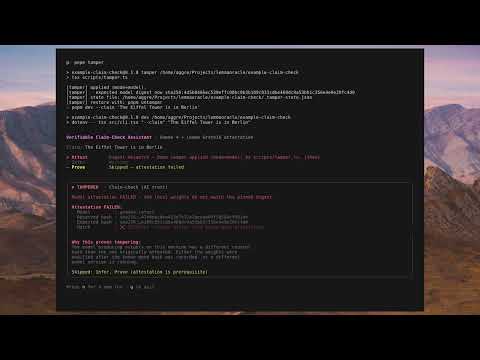
The point of this assistant is what happens when trust breaks. The same hash-compare primitive backs two domains, and the WOW moment shows up in both.
# 1. Run a claim — observe ✔ VERIFIED
pnpm dev

# 2. Simulate a supply-chain tamper (non-destructive — flips the expected hash)
pnpm tamper

# 3. Run the same claim again — observe ✘ TAMPERED in red
pnpm dev

# 4. Restore trust
pnpm untamper# 1. Verify a KYC credential — observe ✔ VERIFIED
pnpm dev -- --mode attribute
# 2. Simulate an issuer-attestation rotation (flips the expected attribute hash)
pnpm tamper:attribute
# 3. Re-run — observe ✘ TAMPERED with "Attribute hash mismatch"
pnpm dev -- --mode attribute
# 4. Restore trust
pnpm untamper# Runs the AI pipeline (Attest/Infer/Prove) then the attribute pipeline
# (AttestAttr/VerifyAttr/ProveAttr) back-to-back, with the banner
# "Same ZK primitive, different domain — AI trust & DeFi compliance, unified."
pnpm dev -- --mode both --claim "The Eiffel Tower is in Paris."
# Flip both expectations at once
pnpm tamper:both
pnpm dev -- --mode both --claim "<text>" # both panels go red
pnpm untamperThe tamper script does not touch any model weights or credentials on disk. It writes .tamper-state.json, which overrides the expected digest used by the attestation steps (expectedDigestOverride for the model, attributeHashOverride for the attribute). The verdict change is identical to a real supply-chain compromise — no actual model file or credential is harmed.
The Groth16 proof step requires compiled circuit artifacts (.wasm + .zkey). These live under circuits/build/ and are built from the Circom source in circuits/:
cd circuits && pnpm buildThe circuit (claimCheckCommitmentV1) takes 5 private inputs (modelDigest, attestationToken, claimHash, outputHash, nonce) and commits them under a single Poseidon root. To register the circuit with the Lemma workers API (IPFS upload + circuits.register), run:
npx tsx scripts/register-circuit.ts| Env var | Default | Purpose |
|---|---|---|
OLLAMA_BASE_URL |
http://127.0.0.1:11434 |
Ollama daemon endpoint |
OLLAMA_MODEL |
gemma4:latest |
Model tag to attest and run |
LEMMA_API_BASE |
https://workers.lemma.workers.dev |
Lemma workers REST API base |
LEMMA_API_KEY |
(unset) | API key for the Prove step (see note below) |
Copy .env.example to .env and fill in values as needed.
API key & the Prove step. The Prove step registers the binding as a Lemma document (
POST /v1/documents) and submits the on-device Groth16 proof (POST /v1/proofs), both of which requireLEMMA_API_KEY. Without a key, Attest and Infer still run and Prove reports a401— or runpnpm dev --offlineto skip Prove entirely. The proof generation itself (snarkjs) runs locally and does not need the API key, but submission does.
CLI flags override env vars. See pnpm dev -- --help for the full list.
example-claim-check/
├── src/
│   ├── sdk/                # Thin Lemma API wrapper (fetch + types; also exports submitProof)
│   ├── ollama/             # Ollama HTTP client (/api/{tags,show,generate})
│   ├── attestation/
│   │   ├── verify.ts       # Model digest readback + known-good comparison
│   │   ├── attribute.ts    # Attribute hash readback + KYC verify
│   │   └── hash.ts         # SHA-256, canonicalise, nonce utilities
│   ├── inference/          # Gemma 4 claim-check prompting (JSON output)
│   ├── proof/              # Poseidon binding + snarkjs Groth16 proving + Lemma submission
│   ├── ui/                 # Ink TUI components
│   └── cli.tsx             # Entry point — --mode claim | attribute | both
├── circuits/
│   └── src/                # Circom source for claimCheckCommitmentV1
│       └── build/          # Compiled .wasm + .zkey (built via pnpm build)
├── scripts/
│   ├── tamper.ts           # WOW demo helper — --mode model | attribute | both
│   └── register-circuit.ts # Upload circuit artifacts to IPFS + register with Lemma
├── config/
│   ├── known-good-hashes.json       # Pinned model manifest digests
│   └── known-good-attributes.json   # Pinned attribute credential hashes
└── LICENSE                 # Apache 2.0
- Lemma SDK (TypeScript, full crypto stack):
lemma/packages/sdk - Lemma OpenAPI spec:
lemma/packages/spec/openapi.lemma.v2.json - x402 reference integration:
example-x402
This is a hackathon-track reference. Per the writeup:
- Edge proving requires compiled circuit artifacts. The proof step generates a Groth16 zero-knowledge proof on-device via snarkjs (Poseidon-commitment circuit
claimCheckCommitmentV1). If thecircuits/build/directory is missing, the proof submission is skipped gracefully with a console warning. - Commitments use the
poseidonscheme. Both claim and attribute modes submit documents withcommitments.scheme: "poseidon"and a Poseidon root — notsha256-placeholder. - Both modes share a single schema. Claim mode and attribute mode both use
schema: "passthrough-v1". - Model attestation covers weight integrity only. A model trained on biased data would still produce biased verdicts — attestation detects post-training tampering, not training-data provenance.
- Source verification is out of scope. The system attests the model, not the corpus the model relies on internally.
Apache 2.0 — see LICENSE.