| Logo | Description |
|---|---|
 |
StoryPlay is a visual editor for building playable narrative games. Design branching stories, track variables, define reusable characters, and add game mechanics using a node-based interface with live preview. Think Twine, but visual, built-in game systems, and a real play/debug mode |


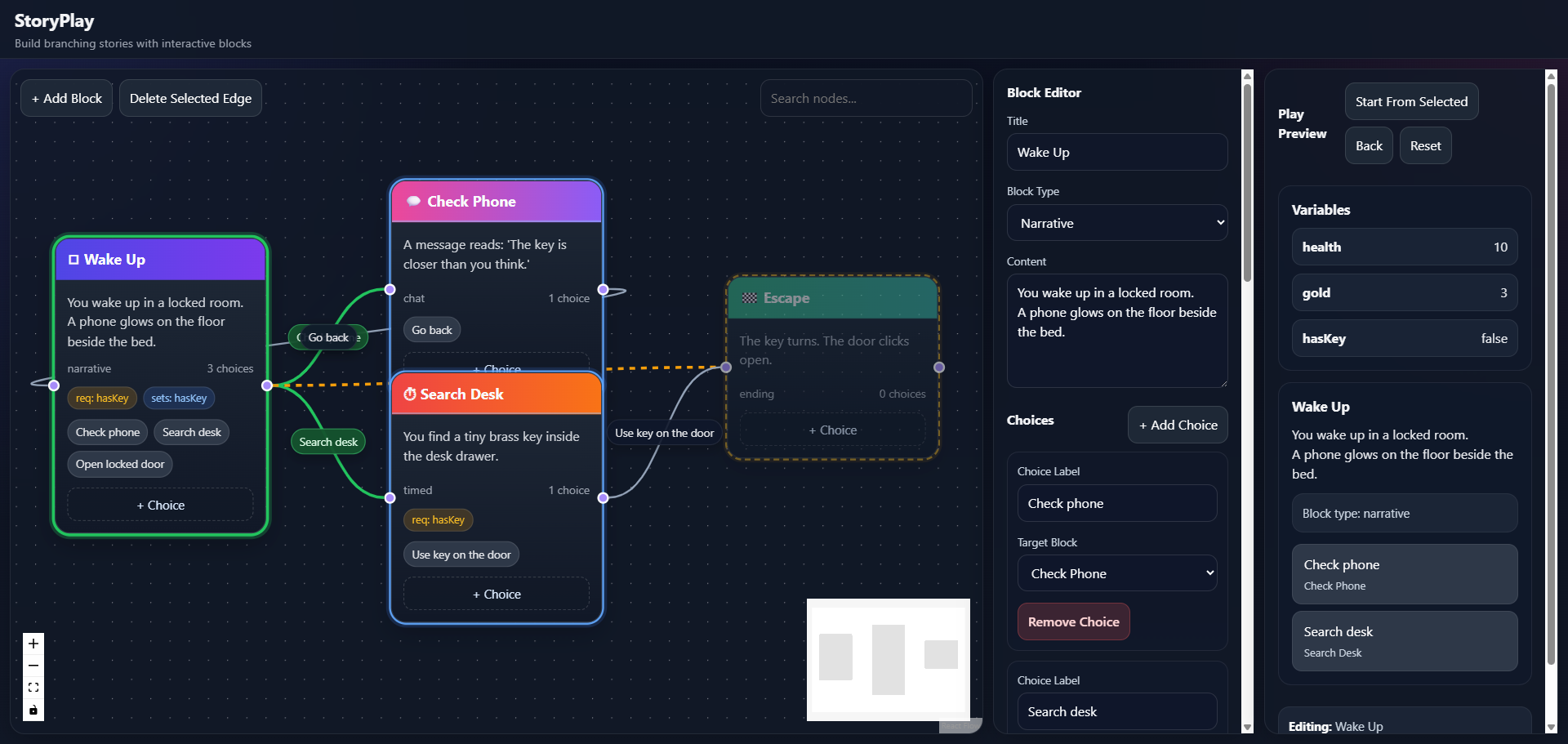









- Narrative — Body text plus branching choices (label, target node, optional conditions and effects on variables).
- Chat — Line-based script rendered as chat bubbles in preview. Opening lines use
Name: message(or character tokens as the speaker). Lines starting withYou:are outgoing. After the opening script, the player picks chat reply choices to continue the conversation in-thread, or go to block choices to leave for another scene.- Chat reply choices support a reply button label, optional player message (what appears in the player’s bubble), and NPC response lines (
Name: messageper line). - Leave After Reply, Go To empty to keep talking in the same block.
- Chat reply choices support a reply button label, optional player message (what appears in the player’s bubble), and NPC response lines (
- Timed — Countdown; at zero the preview can jump to a timeout target node and apply timeout effects (same effect model as choices).
- Ending — Typically has no choices; used as a terminal beat.
Edited in the sidebar summary plus a full-screen mini-game editor (header: Open Mini-Game Editor when a mini-game node is selected):
- Trait picker — Pick traits within min/max counts; optional trait list variable and per-trait variable patches.
- Persuasion — Score, threshold, turns, dialogue lines with deltas; success / failure branch node ids and optional score/success variables.
- Choice weighting — Distribute a fixed point budget across options; optional result variable, variable prefix, and exact-total lock.
Define characters once in the full-screen Characters workspace ({ id, name, description, aliases }).
Insert {{character:char_id.name}} tokens into block content, choice labels, and chat lines. Renaming a character updates every reference at play time. Tokens tolerate optional whitespace (e.g. {{character: char_id.name}}).
Use Insert character in text fields for a dropdown that inserts tokens at the cursor and shows a live preview when tokens are present.
New projects start blank (empty canvas). Load a starter from Example stories in the header (with confirmation if you already have content):
Crossroads(simple branch)Market Day(variables + conditional buy + chat)Timed Nerve(countdown + timeout result)Escape Room(chat + timed + key logic)Guild Audition(trait picker → persuasion → choice weighting → gated endings)
- Graph canvas (React Flow): add nodes, drag positions, draw connections from handles to create choices, search, minimap, controls, background grid.
- Block inspector: title,
blockType, collapsible content (narrative / chat / ending / mini-game prompt), timed timer + timeout wiring. - Choice editor: collapsible choice rows (click the row or the blue ▾ arrow to expand). Targets, conditions (
equals,notEquals, numeric compares, …), effects (set,add,subtract,toggle). Chat blocks add chat reply vs go to block choice types. - Characters workspace and Variables workspace (full-screen editors for story-wide data).
- Story diagnostics (graph health: missing targets, undefined variables in conditions/effects, missing chat NPC responses, etc.).
- Guided tour — Nine-step onboarding on first visit (canvas, add block, sidebar, add choices, expand choices, preview, variables, export, templates). The tour seeds example choices and highlights the expand arrow. Replay anytime via Tutorial in the header.
- Play Preview (sidebar Quick preview): start from selected node, follow allowed choices, Back (history), Reset; supports narrative, chat (staggered reveal, player/NPC reply turns, character token resolution), timed auto-advance, and the three mini-game UIs.
- Play in new tab: opens
#/playplayer mode and keeps that tab in sync with debounced editor snapshot updates after first launch (includescharactersfor token resolution). - Export Game (header): downloads StoryPlay export v1 JSON (
schemas/storyplay-export.v1.schema.json). In dev only:window.__storyplayLogExport()andwindow.__storyplayDownloadExport()in the console.
The file includes formatVersion, optional exportedAt, and story: { variables, characters, nodes } (same shape as editor state). By default, reference tokens in text fields are resolved to current character names on export. Edges are not stored; they are implied by each node’s choices[].targetNodeId. Import and bundled/runtime distribution packaging are still planned; see CHANGELOG.md for limitations and next steps.
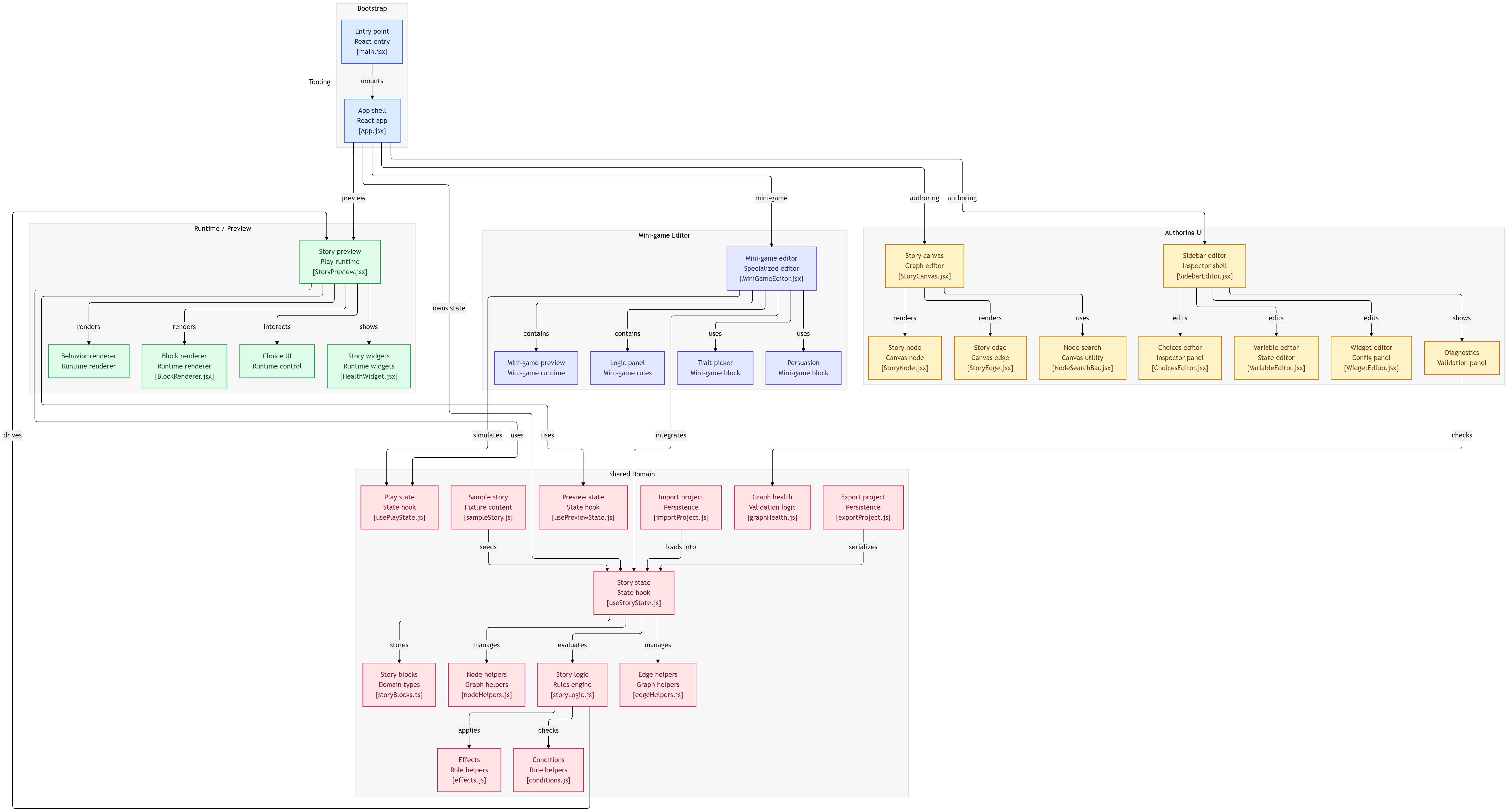
React · Vite · React Flow · JavaScript · TypeScript (mini-game block views and src/types)
npm install
npm run dev
npm run build
Then open http://localhost:5173.
See CHANGELOG.md for release notes and notable changes.
- Import v1 JSON into the editor (with validation and clear errors).
- Runtime application of enter effects on node entry (data exists today; Play Preview does not run them).
- Richer distribution: asset bundling, optional runtime-only export, ZIP or single-file player.
- Additional mini-games (see “Planned mini-games” badges above).
- Puzzle widgets and deeper inventory flows.